November 16, 2025

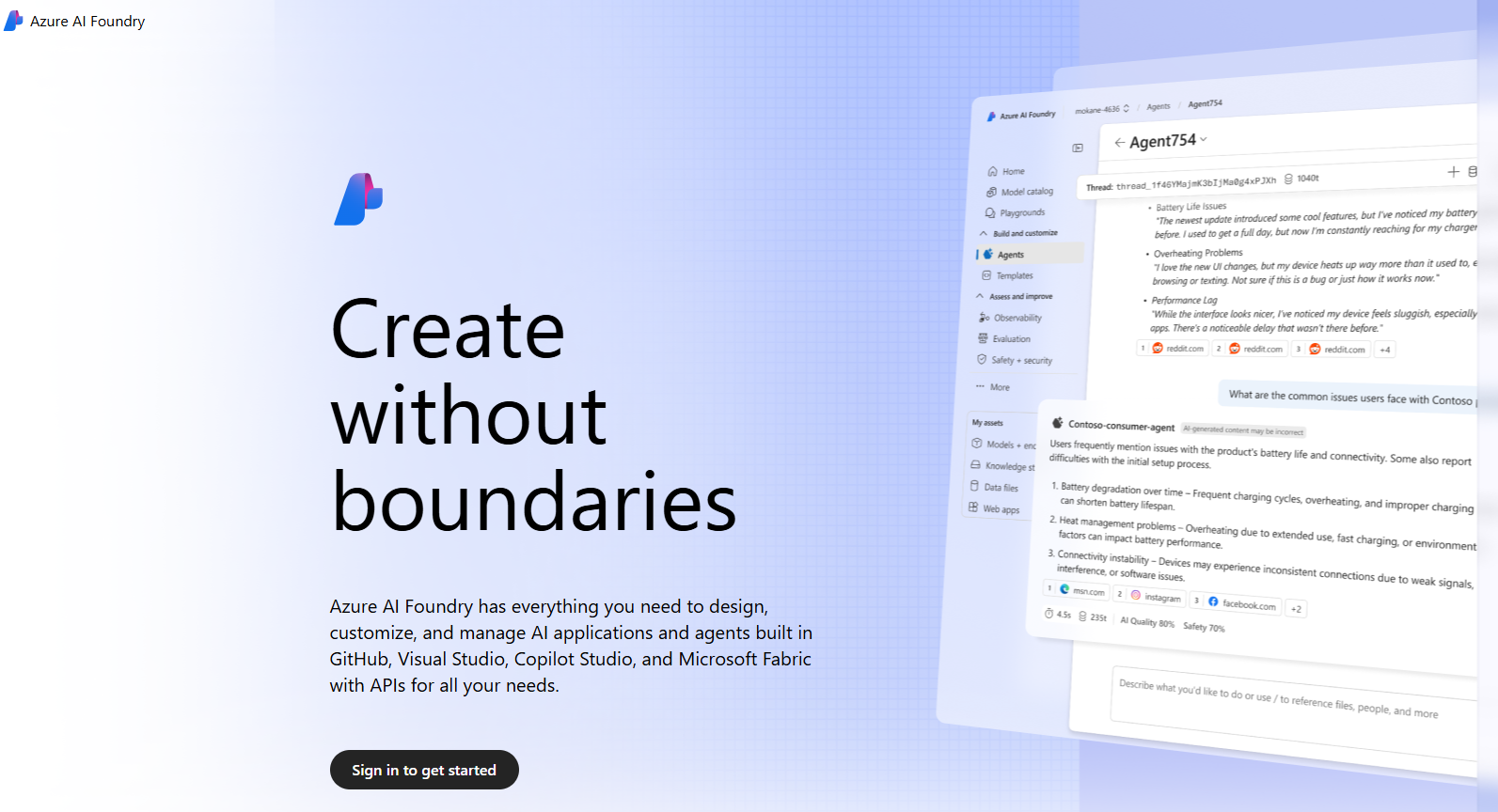

Welcome to the forefront of AI innovation! The world of artificial intelligence is evolving rapidly, and Microsoft is leading the charge with Azure AI Foundry. This powerful platform provides a comprehensive environment designed to help you build, manage, and scale sophisticated AI solutions. Whether you are a seasoned developer or just beginning your AI journey, this blog will explore how you can use the features of Azure AI to turn your ideas into reality and unlock the full potential of this technology.
So, what exactly is Azure AI Foundry? Think of it as your all-in-one workshop for creating AI. It's a unified, web-based platform that brings together all the tools and Azure services you need to develop, train, deploy, and manage machine learning models in one convenient place.
This powerful platform simplifies the entire lifecycle of generative AI development. By integrating with the robust infrastructure of the Azure cloud, the AI Foundry offers unmatched scalability, security, and reliability, making it easier than ever to build powerful AI applications.
The core idea behind AI Foundry is to create an efficient, streamlined process for AI development, much like an assembly line for manufacturing. It takes the complex, multi-stage journey of building an AI solution and organizes it into a smooth, manageable workflow. This approach helps you move from an initial idea to a production-ready application faster.
A key principle is enabling the creation of advanced agentic AI. These are intelligent agents capable of handling complex workflows and tasks. The platform provides access to state-of-the-art large language models and integrated tools, empowering you to build agents that deliver real business value.
This philosophy is rooted in years of Microsoft Research, which aims to make AI more accessible and powerful. By providing a structured yet flexible environment, the AI Foundry allows developers to focus on innovation instead of getting bogged down by infrastructure and manual processes.
Azure AI Foundry is not a standalone product; it's deeply woven into the fabric of the broader Azure ecosystem. It acts as a central point, leveraging the power of other Azure services like Azure Machine Learning, compute, storage, and networking to maximize the efficiency of AI development.
The architecture is built around the Azure AI Foundry Hub, a collaborative space that connects teams with shared resources. This hub provides access to pretrained models, data, and compute resources, ensuring that everyone is working from the same playbook. This integration simplifies resource management and promotes consistency across projects.
This seamless connection to the Azure ecosystem means you can easily scale your solutions, manage security, and handle deployment from a single, unified interface. It creates a cohesive experience where all the necessary tools and services work together harmoniously, accelerating your path from development to deployment.
The architecture of Azure AI Foundry is designed for simplicity and power, integrating various services to deliver a seamless AI development experience. The core components work together to help you build, deploy, and manage AI solutions efficiently, from experimentation to production.
At its heart are elements like the Azure AI Foundry Hub, which provides a collaborative project management layer, and the Foundry Agent Service, which helps you design and scale production-grade AI agents. Understanding these pieces is key to unlocking the platform's full potential.
Azure AI Foundry offers a unified platform that simplifies the entire AI development process. Through the AI Foundry Portal, you get a web-based experience that supports everything from initial ideas to full production deployment. It’s designed for collaboration, allowing you to easily invite team members to work alongside you.
This environment supports the tools you already love. You can seamlessly integrate your work with platforms like Visual Studio Code and GitHub, making it easy to fit AI Foundry into your existing workflows. This flexibility ensures you don't have to change how you work to leverage its powerful capabilities.
The focus on a unified experience extends to automation. The platform helps you organize your workflows, save your progress, and iterate on your projects without losing momentum. This approach reduces complexity and makes AI a more natural part of your daily operations.
A major strength of Azure AI Foundry is its deep integration with other key Azure services. For instance, it connects seamlessly with the Azure OpenAI Service, giving you access to powerful generative AI models like GPT through a secure and scalable REST API.
The platform also includes the Management Center, a centralized dashboard for overseeing all your AI resources. From here, you can manage user roles, monitor billing, and ensure compliance across all your projects. This hub provides the control and visibility needed for enterprise-level AI governance.
Project workspaces are another crucial component, offering focused environments for specific AI solutions. These integrations create a cohesive ecosystem:
Azure AI Foundry is packed with features designed to accelerate your AI journey and drive innovation. This powerful platform goes beyond basic model training, offering a comprehensive suite of tools that support the entire AI lifecycle.
From a rich model catalog to native MLOps support, these features help your team respond quickly to new opportunities. You will find tools for creating streamlined workflows, ensuring data governance, and maintaining observability over your deployed models. Let’s explore some of these standout functionalities.
The AI Foundry Model Catalog is a curated library that gives you access to over 1,600 foundation models. This extensive collection includes top-tier models from industry leaders like OpenAI, Meta (Llama), Mistral, and Hugging Face, giving you a wide range of options to choose from. You can even find specialized art models for creative projects.
This catalog simplifies the process of finding the right model for your needs. You can explore, benchmark, and fine-tune these models to create customized AI solutions that align with your specific business requirements. Whether you need a model for text generation, code development, or image creation, the catalog has you covered.
Having access to such a diverse set of models in one place streamlines development and allows for rapid prototyping and deployment.
Model Provider
Popular Models
Primary Use Cases
OpenAI
GPT series, Sora
Natural language, code generation, video creation
Meta
Llama family
Open-source, highly customizable text generation
Mistral AI
Mistral models
Efficient and powerful language models
Hugging Face
Various
A vast collection of open-source models for diverse tasks
Azure AI Foundry brings robust MLOps capabilities directly into your workflow, making it easier to manage the entire lifecycle of your AI models. The platform offers native support for automating model training, testing, deployment, and monitoring. This automation helps you maintain consistency and quality as you move from development to production.
With built-in integrations for GitHub and Azure DevOps, you can implement CI/CD pipelines for your AI projects. This allows for continuous integration and delivery, ensuring that your models are always up-to-date and performing as expected. The orchestration tools simplify the management of complex workflows.
This focus on automation and MLOps provides incredible scalability. You can use pre-built templates to quickly set up deployment pipelines and manage them with ease, whether you're deploying to the cloud, on-premises, or at the edge.
Once your AI solution is deployed, how do you ensure it continues to perform well? Azure AI Foundry provides powerful tools for observability and monitoring, giving you real-time visibility into your models' behavior. These tools help you track performance, detect drift, and analyze outcomes to ensure your models deliver on their business goals.
This level of performance tracking is essential for maintaining production-ready standards. You can supervise everything from token usage to response latency, allowing you to optimize your applications for cost and efficiency. The platform also includes features like content filtering to enhance safety and reliability.
Key monitoring features give you the insights needed to maintain high-quality AI solutions:
Now that you understand the core features, let's talk about putting them into action. Building AI solutions with Azure AI Foundry is a hands-on process designed to take you from a simple idea to a fully functional app or AI agent.
The platform provides all the tools you need to design, prototype, and deploy custom AI that can automate business processes and streamline complex workflows. The following sections will guide you through the practical steps of developing your own AI solutions and fostering collaboration within your team.
Developing and deploying an AI model in Azure AI Foundry follows a clear, structured path. You can start by exploring the model catalog to find a foundation model that fits your needs. From there, you can customize it with your own data to create a solution tailored to your business.
The platform simplifies the creation of workflows with tools for prompt design and orchestration. Once your model is ready, you can deploy it as a serverless API, making it accessible to your applications without heavy infrastructure management. Integration with tools like GitHub and Azure Machine Learning ensures a smooth CI/CD process.
Here's a simple, repeatable process to get you started:
Collaboration is at the heart of successful AI development, and Azure AI Foundry is built to bring teams together. The platform provides a shared environment where data scientists, ML engineers, and software developers can co-create and monitor AI projects from a single place.
The AI Foundry Portal acts as a central hub for teamwork. It offers enterprise-grade security and shared access to resources, ensuring that everyone on the team is on the same page. Project workspaces further enhance collaboration by providing isolated environments for specific projects, containing all the necessary data sources, notebooks, and models.
This collaborative framework breaks down silos between different roles. Developers can work in their preferred tools like Visual Studio Code, while data scientists can experiment in notebooks, all within the same connected ecosystem. This synergy helps accelerate the journey from an initial app prototype to a polished, production-ready solution.
When working with AI, especially with sensitive enterprise data, security is non-negotiable. Azure AI Foundry is designed with enterprise-grade data security, governance, and compliance at its core. The platform includes a suite of built-in features to protect your applications and data.
From robust identity and access controls to tools for content safety, the platform provides the safeguards you need to build trustworthy AI. The following sections will cover how these features help you meet strict regulatory requirements and manage access securely.
Azure AI Foundry provides robust identity management to ensure only authorized users and services can access your resources. With Microsoft Entra Agent ID, every AI agent you build gets a unique identity, just like a human user. This allows you to apply specific access controls and permissions for each agent.
This level of control is crucial for protecting your enterprise data. You can set up role-based access controls to enforce the principle of least privilege, ensuring that users and agents only have access to the data they absolutely need. All data is protected with strong encryption, both at rest and in transit.
These identity and access management features are part of a comprehensive governance framework. Security admins can monitor sign-in activities, apply conditional access policies, and manage permissions from a central location, giving you full visibility and control over your AI environment.
Building trustworthy AI means ensuring your models behave responsibly and safely. Azure AI Foundry includes built-in controls for content safety that help you detect and mitigate harmful or inappropriate content. Features like Prompt Shields protect your applications from malicious prompt injections, whether from users or incoming data.
To help with regulatory compliance, the platform provides guardrails to prevent AI agents from revealing sensitive information or straying from their approved tasks. These controls are essential for operating in regulated industries and meeting standards like GDPR and HIPAA. An AI Red Teaming Agent constantly probes for vulnerabilities, so you can fix them before deployment.
The platform's governance tools offer out-of-the-box integrations with services like Microsoft Purview to track model performance, fairness, and compliance requirements. This comprehensive approach to safety and governance helps you build AI solutions that you and your users can trust.
The true power of Azure AI Foundry is revealed in its real-world applications. The platform's versatility allows it to deliver real business value across various industries by transforming complex business processes through automation and intelligent agents.
From enhancing customer interactions to optimizing internal operations, the use cases are vast. These examples are entry points for exploring what is possible for your organization and can inspire you to reimagine processes in ways you might not have considered before.
One of the most impactful use cases for Azure AI Foundry is revolutionizing the customer experience. By leveraging pre-trained models and natural language processing capabilities, you can deliver highly personalized interactions and proactive support that delight your customers.
For example, you can build chatbots powered by a large language model to provide instant, 24/7 customer service or analyze customer feedback at scale using sentiment analysis. This level of automation frees up your human agents to focus on more complex issues, improving overall efficiency and satisfaction.
Here's how AI can elevate the customer experience:
Beyond customer-facing applications, Azure AI Foundry is a powerful tool for optimizing internal business operations. By implementing AI-driven automation, you can significantly improve efficiency, reduce errors, and free up your employees to focus on more strategic tasks.
Imagine automating invoice processing with document recognition APIs or using predictive analytics to forecast demand and streamline your supply chain. An AI agent can be deployed to detect fraudulent transactions by analyzing patterns in real time, protecting your business from financial loss.
These capabilities not only enhance efficiency but also drive innovation:
Hearing from those who have already adopted Azure AI Foundry provides invaluable insights. Real-world applications have taught users important lessons about best practices, common hurdles, and how to extract real business value from the platform.
These experiences highlight the importance of starting with clear goals and implementing strong governance from day one. By learning from early adopters, you can accelerate your own AI journey and avoid common pitfalls. Let’s look at some key takeaways and tips for maximizing your success.
One of the most common takeaways from users is the importance of a strong governance framework. Establishing clear rules for data access, model deployment, and monitoring from the very beginning is crucial for building scalable and trustworthy AI solutions with AI Foundry.
Another key best practice is to start small and iterate. Instead of trying to automate entire business processes at once, successful users often begin with a well-defined, high-impact problem. This allows them to demonstrate value quickly and build momentum for larger projects.
Here are a few best practices shared by experienced users:
While Azure AI Foundry is incredibly powerful, users sometimes face challenges related to cost management and complexity. The vast array of options can be overwhelming, and without proper planning, costs can escalate, particularly with real-time, high-traffic applications.
To maximize value, it's important to carefully select the right model and compute resources for your task. The platform's monitoring tools are essential for tracking usage and optimizing for cost. For instance, the new developer tier for fine-tuning has no hosting fees, making experimentation more accessible.
Here are some tips for overcoming common challenges:
Azure AI Foundry is not just about the tools available today; it is also a platform for future innovation. Through initiatives like Azure AI Foundry Labs, Microsoft is exploring the next frontiers of AI and giving users a preview of what's to come.
These labs are where groundbreaking research turns into tangible new capabilities. They offer a glimpse into the future of AI development, from autonomous agents that can build entire ML pipelines to new models that accelerate scientific discovery. Let's explore what these labs are and who can benefit from them.
Azure AI Foundry Labs is an innovation program that provides a sneak peek into the future of AI. It’s a space where Microsoft Research shares its latest inventions, allowing you to experiment with cutting-edge technologies before they become widely available. These are forward-looking projects available in preview through the Foundry Portal.
The labs are ideal for developers, researchers, and innovators who want to stay ahead of the curve. If you're interested in exploring next-generation capabilities, such as autonomous agents or new human-agent interaction models, this is the place for you.
Access to the labs allows you to test concepts like Project Amelie, an autonomous agent that can build a complete ML app from a single prompt, or Magentic-UI, an open-source agent for web-based tasks. It's a playground for those looking to push the boundaries of what's possible with AI.
The future of Azure AI Foundry is focused on making AI more powerful, accessible, and agile. Ongoing advancements aim to enhance the platform with new capabilities, from more efficient model training to deeper integration with emerging technologies like quantum computing and edge AI.
Future releases will provide even more granular visibility into model performance and cost, allowing you to better optimize your AI investments. Additionally, Microsoft is committed to improving support for edge computing, which will enable real-time AI applications in low-connectivity environments.
These future developments show how Azure AI is shaping the future of AI development. By focusing on serverless architecture and continuous innovation, the platform is evolving to help businesses stay competitive in a dynamic market, ensuring you always have access to the latest breakthroughs.
KeywordSearch has an AI Audience builder that helps you create the best ad audiences for YouTube & Google ads in seconds. In a just a few clicks, our AI algorithm analyzes your business, audience data, uncovers hidden patterns, and identifies the most relevant and high-performing audiences for your Google & YouTube Ad campaigns.
You can also use KeywordSearch to Discover the Best Keywords to rank your YouTube Videos, Websites with SEO & Even Discover Keywords for Google & YouTube Ads.
If you’re looking to SuperCharge Your Ad Audiences with AI - Sign up for KeywordSearch.com for a 5 Day Free Trial Today!
In summary, Azure AI Foundry stands out as a powerful platform that simplifies the development and deployment of AI models. With its robust architecture, seamless integration with existing Azure services, and a wealth of features designed for observability and performance tracking, it caters to both seasoned data scientists and newcomers. The emphasis on security, compliance, and governance ensures that organizations can trust their AI initiatives while optimizing operations and enhancing customer experiences. As you explore the capabilities of Azure AI Foundry, consider how these tools can be integrated into your projects to drive innovation and efficiency. If you're eager to dive deeper, connect with us for a free consultation to discuss tailored solutions for your business needs!
The Azure AI Foundry model catalog offers a vast selection of over 1,600 models. You can access state-of-the-art foundation models from industry leaders like OpenAI, Meta (Llama), Mistral, and Hugging Face, enabling you to find the perfect starting point for any AI project within the Azure AI environment.
Azure AI Foundry addresses enterprise security with a comprehensive governance framework. It includes features like role-based access controls, robust encryption for enterprise data, and built-in tools for regulatory compliance. This allows you to build trustworthy AI solutions that meet the strictest security and privacy standards within the Azure AI platform.
Yes, Azure AI Foundry is designed for businesses of all sizes. Its scalability allows small businesses to start with manageable projects and grow as their needs evolve, while large enterprises can leverage its powerful automation and governance features to manage complex business processes and deploy AI solutions at scale.