January 13, 2026


Welcome to the world of AI-driven automation! In today's fast-paced business environment, companies are constantly looking for ways to improve efficiency and reduce manual work. This is where UiPath comes in. As a leader in robotic process automation (RPA), UiPath provides a powerful platform to automate routine tasks using software robots and artificial intelligence. This guide will explore what UiPath is, its key features, and how it can transform your business processes for the better.Regarding investment potential, UiPath's recent stock performance has shown periods of volatility, which is common for technology companies in emerging sectors like RPA. Investors considering UiPath should evaluate the company's long-term growth prospects and strong market position, as these factors may influence whether it is a good investment despite short-term fluctuations.
UiPath is a powerful robotic process automation tool designed for end-to-end automation on a large scale. It offers solutions that help businesses automate routine office activities, transforming tedious tasks into streamlined, automated processes. This allows your IT department to deploy software robots that gather and interpret data across various applications.
The significance of UiPath lies in its ability to accelerate business transformation through AI-driven automation. By simplifying how companies build and manage automation, it paves the way for increased productivity and innovation. Let's look closer at its purpose and how it impacts businesses.
So, what is UiPath and how is it used for automation? At its core, UiPath is a software platform built to automate business processes from start to finish. It provides the tools necessary to design, deploy, and manage software robots that mimic human actions to perform a wide variety of tasks.
The primary purpose of the platform is to enable accelerated business change. It achieves this by providing solutions that automate repetitive office activities. By using a variety of methods to turn tedious tasks into fully automated workflows, UiPath helps organizations become more agile and efficient.
Ultimately, the vision for UiPath is to deliver a future where AI-driven automation is seamlessly integrated into every facet of business automation. This means empowering companies to not only handle simple tasks but also to tackle complex processes, driving significant improvements in productivity and allowing employees to focus on more strategic work.
UiPath fundamentally changes how businesses approach digital transformation. By implementing robotic process automation, you can offload mundane and repetitive tasks to software robots. These bots can interact with digital systems just like a human would—navigating screens, entering data, and extracting information—but with greater speed and accuracy.
This transformation allows your employees to shift their focus from monotonous work to activities that require critical thinking and creativity. How does UiPath help organizations implement AI-driven automation? It provides an accessible platform that turns complex business processes into manageable, automated workflows, leading to significant gains in operational performance.
The impact on businesses is profound and multifaceted. Here are a few key benefits:
At the heart of creating powerful automation is UiPath Studio. This is the user-friendly environment where you can visually design and build automation workflows. It acts as a digital canvas, allowing developers and even non-technical users to map out processes using simple drag-and-drop actions.
The key features of UiPath Studio make it one of the most versatile RPA tools available. It provides everything you need to record actions, integrate AI, and handle complex data. Below, we'll explore some of its most important capabilities.
One of the most celebrated features of UiPath Studio is its intuitive drag-and-drop workflow designer. This feature allows you to build visual process steps by simply dragging related activities onto a graphical workspace. You can then configure these steps to create a complete, functional automation workflow without writing extensive code.
This visual approach to process automation dramatically lowers the barrier to entry. You don't need to be a seasoned developer to start creating useful bots. For even faster development, UiPath Studio includes a recorder wizard that can watch your actions on the screen and automatically convert them into a workflow.
Whether you are building automation for a web-based application or a desktop program, the drag-and-drop interface and recording options make the process faster and more accessible. This is a core reason why UiPath is a leader among RPA tools for building scalable automation workflows.
UiPath goes beyond simple task automation by integrating artificial intelligence and machine learning. Through the UiPath AI Center, you can incorporate pre-built or custom AI models directly into your automation workflows. This adds a layer of intelligence that allows your bots to handle more complex and nuanced tasks.
How does UiPath help organizations implement AI-driven automation? It provides a flexible, drag-and-drop interface within UiPath Studio that makes AI integration seamless. You can easily add ML models to your workflows for rapid testing and scaling, all while monitoring their performance with end-to-end data visibility.
This powerful combination of AI and automation unlocks new possibilities. Here are a few examples of what you can achieve:
A critical part of many business processes is getting information from various sources. UiPath excels at data extraction with its advanced screen scraping capabilities. This feature allows you to efficiently pull data from different UI elements, documents like a PDF, and web pages, even if they lack traditional APIs.
UiPath Studio offers several scraping methods to ensure you can get the data you need. The FullText method is fast and accurate, while the Native method can extract text position and hidden information. For challenging environments like Citrix, Optical Character Recognition (OCR) provides a powerful solution. This flexibility ensures you can automate data extraction from nearly any program, including .Net, Java, SAP, and legacy systems.
The data scraping wizard further simplifies this process, helping you extract data that has a repetitive structure. This capability is invaluable for tasks that involve document processing or moving information from one system to another, making it one of the key features of UiPath Studio.
As automation technology evolves, we are moving toward a future of more autonomous systems. This is where agentic automation comes in. It represents a shift from bots that simply follow instructions to intelligent agents that can manage entire processes, make decisions, and operate with minimal human oversight.
UiPath is at the forefront of this evolution, providing the tools to build these next-generation autonomous business processes. By combining RPA with advanced AI, the platform enables the creation of automation that is more proactive and independent. Let's examine what makes this new form of automation so unique.
What is agentic automation and how is UiPath involved in it? Unlike traditional automation that executes a predefined set of steps, agentic automation introduces a level of autonomy. These AI-driven agents can understand goals, analyze situations, and decide on the best course of action to achieve an outcome, much like a human employee would.
This approach is defined by its advanced capabilities to handle dynamic environments and complex processes. It moves beyond simple task execution to orchestrate end-to-end autonomous business processes, reducing the need for constant human intervention and supervision. The result is a more resilient and intelligent automation ecosystem.
Here are some unique characteristics of agentic automation:
UiPath is deeply involved in making autonomous business processes a reality. The platform's integrated suite of tools, combining RPA, artificial intelligence, and process mining, provides the foundation for building this next level of business automation. This approach empowers organizations to design workflows that can run independently from start to finish.
The goal is to minimize human intervention wherever possible. By leveraging AI, UiPath enables bots to handle exceptions, make judgments, and interact with complex systems without needing to escalate to a person for every minor issue. This creates a truly autonomous workforce of software robots that can manage entire business functions.
This vision of automation is not just about efficiency; it's about creating more resilient and intelligent operations. As UiPath continues to enhance its platform, the ability to create, manage, and scale these autonomous processes will become central to modern business strategy, further solidifying the platform's role as a leader in the industry.
To fully grasp how UiPath works, it's helpful to understand its architecture. The platform is built around a client-server model, with components that handle everything from designing automation to executing and managing it. This structure ensures that the entire RPA platform is scalable, secure, and robust.
The core components of the UiPath architecture are UiPath Studio, UiPath Robots, and UiPath Orchestrator. Each plays a distinct but interconnected role in the automation lifecycle. Let's break down what each of these components does and how they work together.
The UiPath RPA platform is composed of three essential components that work in harmony. UiPath Studio is the design environment. It’s a user-friendly tool where you create automation workflows using a visual, drag-and-drop interface. This is where your automation ideas take shape.
Once a process is designed in the Studio, it's ready to be executed. This is the job of the UiPath Robots. These software robots are the digital workers that run the automation, carrying out the tasks you've defined. They can run on a user's desktop (attended) or in the background on a server (unattended).
Finally, UiPath Orchestrator is the centralized management hub. This web-based application allows you to deploy, schedule, monitor, and control all of your software robots and processes. It ensures your automation runs smoothly and provides analytics on performance.
Component
Function
UiPath Studio
The visual design canvas for building automation workflows.
UiPath Robot
The execution agent that runs the automated processes.
UiPath Orchestrator
The web-based platform for managing, deploying, and monitoring all robots and processes.
As you expand your RPA automation, security and scalability become critical. UiPath is designed with enterprise-grade features to address both. For security, the platform offers functionalities like high-security auto-login for bots, allowing them to run processes even on locked screens. This ensures automated tasks can run in complete privacy without exposing sensitive information.
This focus on security provides the governance needed to deploy automation confidently across the organization. Access to data is strictly controlled and logged, minimizing the risk of information leakage between different components or processes.
When it comes to scalability, the UiPath Orchestrator is key. It allows you to manage a growing fleet of robots from a central point, ensuring consistent performance and operational efficiency. You can easily deploy new processes, manage robot workloads, and scale your automation efforts up or down based on demand, all while maintaining control and visibility.
UiPath isn't just a theoretical tool; it's being actively used by top-tier companies around the world to drive real digital transformation. Its widespread industry adoption is a testament to the power and flexibility of its RPA technologies. Businesses across the United States and globally are leveraging UiPath to enhance productivity and gain a competitive edge.
From financial services to healthcare, organizations are finding innovative ways to apply UiPath to their unique challenges. The following sections will highlight some specific examples of how different industries are benefiting from this powerful automation platform.
Different industries are adopting UiPath for various reasons, but the common thread is the need to automate manual, rule-based processes. In banking, for example, RPA automation is used to handle high-volume tasks that require precision and compliance, such as processing loan applications and performing Know Your Customer (KYC) checks.
Healthcare is another sector seeing significant benefits. UiPath helps streamline administrative tasks like patient appointment scheduling and managing medical records, freeing up staff to focus on patient care. The ability to handle sensitive data securely makes it an ideal solution for this highly regulated industry.
Here are some common use cases across sectors:
Enterprises across the United States are increasingly choosing UiPath as their preferred platform for digital transformation. One of the main reasons is its ability to deliver a clear and rapid return on investment. Companies in demanding sectors like financial services and healthcare need solutions that improve operational efficiency without disrupting existing systems, and UiPath delivers on that promise.
The platform's comprehensive nature, from process discovery to managing large-scale automation workflows, makes it a strategic choice. It supports both modern and legacy systems, allowing businesses to automate processes across their entire technology stack. This flexibility is crucial for large organizations with complex IT environments.
Furthermore, the growing ecosystem of support, training, and a strong developer community in the U.S. makes adopting UiPath easier. As more companies share their success stories, the momentum builds, cementing UiPath's position as a leader in the American market for automation.
KeywordSearch has an AI Audience builder that helps you create the best ad audiences for YouTube & Google ads in seconds. In a just a few clicks, our AI algorithm analyzes your business, audience data, uncovers hidden patterns, and identifies the most relevant and high-performing audiences for your Google & YouTube Ad campaigns.
You can also use KeywordSearch to Discover the Best Keywords to rank your YouTube Videos, Websites with SEO & Even Discover Keywords for Google & YouTube Ads.
If you’re looking to SuperCharge Your Ad Audiences with AI - Sign up for KeywordSearch.com for a 5 Day Free Trial Today!
In conclusion, exploring UiPath reveals a transformative approach to automation that empowers businesses across various industries. From its intuitive features in UiPath Studio to the innovative concept of agentic automation, it offers a robust platform for enhancing operational efficiency. As organizations increasingly adopt AI-driven solutions, understanding the architecture and components of UiPath becomes essential for leveraging its full potential. Whether in banking, healthcare, or other sectors, UiPath is shaping the future of automation, making it easier for enterprises to navigate their digital transformation. If you're ready to elevate your business processes with UiPath, don’t hesitate to reach out and start your journey toward intelligent automation today!
UiPath stands out among RPA tools due to its comprehensive, end-to-end platform. It combines a user-friendly design interface with powerful AI integration and robust governance features. This makes the UiPath RPA solution a leading choice for businesses looking to scale their process automation initiatives from simple tasks to complex business automation.
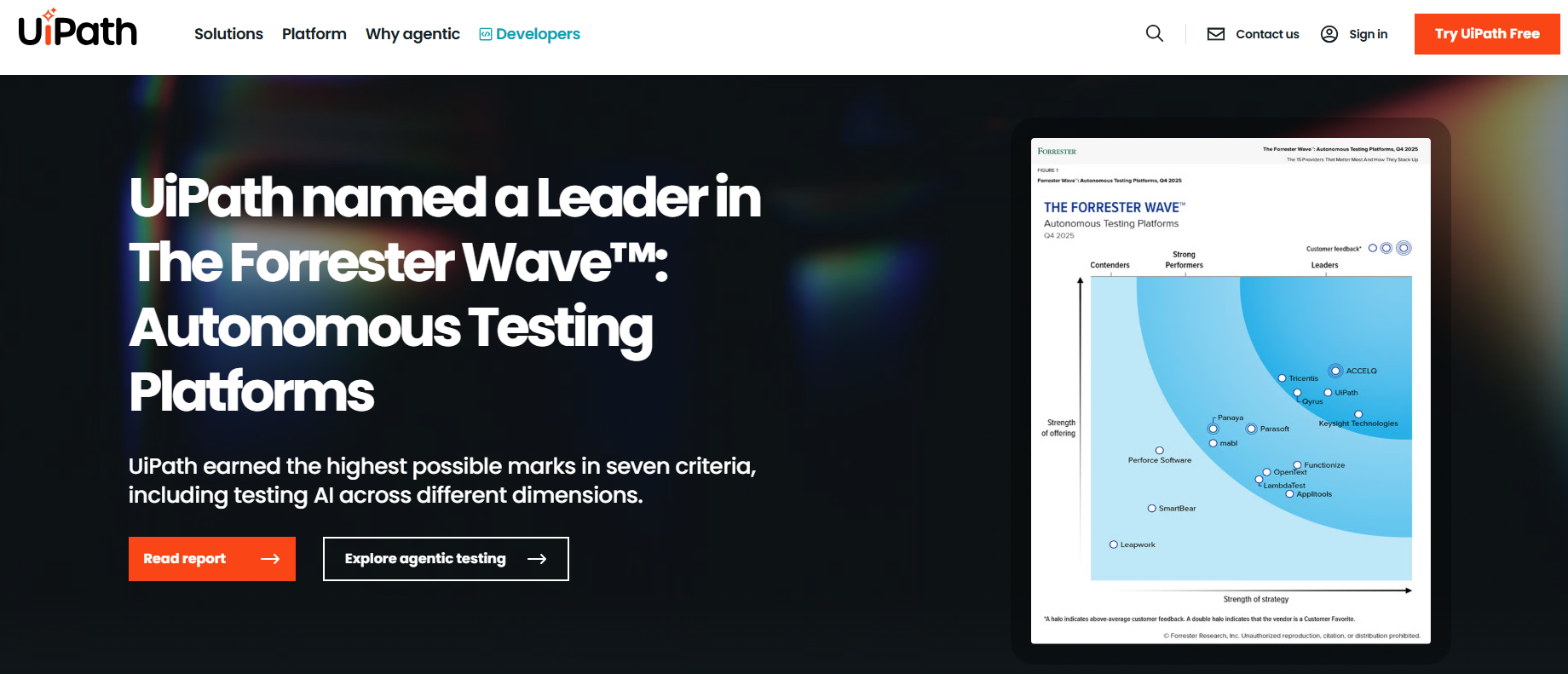
The provided information does not offer direct investment advice on UiPath stock. However, it highlights that UiPath is recognized as an industry leader by analysts like Forrester and has strong adoption across the United States. Any investment decision regarding its stock requires personal research into market conditions, company valuation, and financial performance.
While the provided materials focus on the platform's features, the company's vision is clearly centered on advancing AI-driven business automation. The leadership, including founder Daniel Dines, aims to push the boundaries of what's possible, shaping the company future by making automation more intelligent, accessible, and integral to every enterprise.